
2026-05-29
Heavy-duty insulated pallet containers are used in industries where temperature stability, hygiene control, and safe bulk movement are operational requirements. Many businesses face repeated challenges such as temperature gain during transit, product spoilage, contamination exposure at transfer points, leakage and meltwater mess, and packaging damage caused by rough handling or long-distance movement. These issues become more serious in food, dairy, seafood, pharmaceutical, and chemical lanes, where product quality is directly linked to safety outcomes and customer trust.
Insulated pallet containers are designed to reduce these risks by combining a rigid pallet-based structure with insulation and a controlled enclosure. They support bulk storage, staged holding, and logistics movement while reducing handling exceptions across the route. In practice, the value is not only “keeping goods cold,” but improving repeatability, reducing losses, and making hygiene routines more consistent.
This guide explains what insulated pallet containers are, why they matter, their key benefits, and how to choose the right container for industrial and food applications. It also covers the practical problems businesses face without insulated containers, the features that define heavy-duty performance, and the maintenance steps that improve service life and cost efficiency over time.
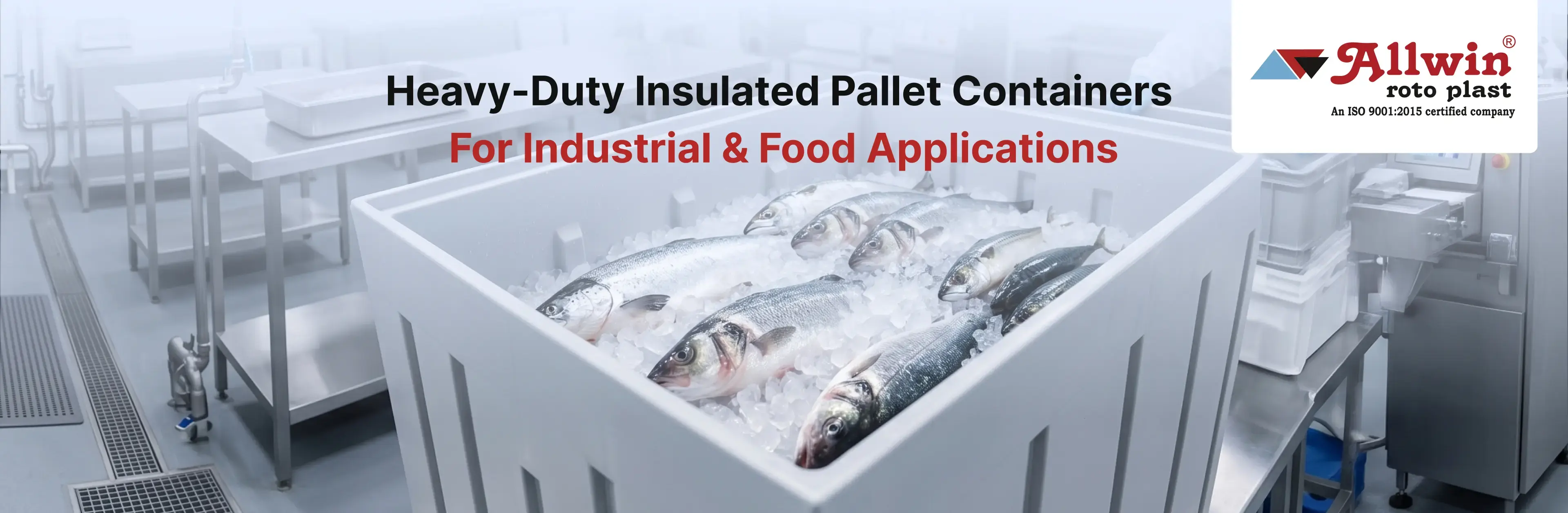
Insulated pallet containers are bulk enclosures built on a pallet base that help reduce temperature change during storage and transport. These insulated plastic pallet containers are handled like pallets by forklifts, but they function like controlled bulk storage units for sensitive goods. They are used when cartons, open bins, or non-insulated containers create too much exposure risk or too many handling failures. In many operations, they sit between smaller insulated storage bins used for handling and full cold-room infrastructure, offering palletised protection without complicating bulk movement.
Most businesses adopt insulated bulk containers when they need stronger protection across multiple touchpoints, especially in lanes with loading delays, staging, or long routes. “Heavy-duty” indicates a stronger structural build for repeated cycles, including stronger walls, better impact tolerance, and stable handling. The correct selection is always lane-based, not generic.
In practical terms, insulated pallet containers provide:
Temperature-sensitive supply chains depend on control across multiple handoffs, not only cold rooms. Exposure often occurs during loading bays, transfer delays, staging windows, or in long-distance movement where conditions vary. This is why temperature controlled pallet containers are used as risk-control packaging rather than as optional logistics accessories.
The importance extends beyond food. Pharmaceutical and industrial lanes often require better containment, reduced exposure, and repeatable hygiene routines. In audited environments, packaging and handling practices must support product integrity and reduce contamination risk. Insulated pallet containers provide operational consistency when the cost of failure is high.
Why many businesses prioritise insulated containers:
The strongest benefit is reduced variability. When temperature gain, leakage, and damage are controlled, the lane becomes more stable and easier to manage. This reduces hidden costs such as cleaning labour, product downgrades, and repeated packaging replacement. Over time, it also improves operational planning because the container behaves predictably across cycles.
In addition to temperature support, insulated containers often improve hygiene discipline because enclosed surfaces can be cleaned and inspected more consistently. This is why hygienic insulated containers are preferred in lanes where cleanliness and inspection confidence matter. Many businesses also prefer reusable insulated pallet boxes because the cost-per-trip improves when return loops are disciplined. For repeat shipments and high-handling environments, heavy duty pallet containers are often selected to reduce packaging failures, limit leakage-related cleanup, and improve consistency across staging and transit cycles.
Key operational benefits:
Insulated pallet containers are typically deployed lane-by-lane. Businesses use them where product sensitivity, route conditions, or compliance expectations justify controlled packaging. They are especially common where temperature drift causes quality loss, where hygiene risk is high, or where rough handling leads to repeated packaging failures.
These containers appear across food, dairy, seafood, pharma, and industrial materials. They may function as cold storage pallet containers for staged holding or as insulated logistics containers for shipment movement. Export and consolidated shipping is also a common application, because delays and ambient exposure are harder to control.
Typical application categories include:
Read More: Insulated Plastic Containers and Pallets: Ensuring Safe Delivery of Your Items
Food supply chains require stable temperature handling and repeatable hygiene routines. Even short exposure windows can affect texture, freshness, and shelf-life outcomes. That is why food grade insulated containers are commonly used for bulk movement, where staging time and multiple handoffs are unavoidable.
Food logistics is also audit-led in many networks, which increases focus on washdown and inspection discipline. Containers must be cleanable, stable in staging, and able to handle repeated cycles without retaining residue or odour. This is why insulated pallet containers are widely adopted in structured food distribution.
Where insulated pallet containers fit in food lanes:
Dairy operations are sensitive to both temperature and hygiene. Bulk movement can create risks such as spoilage, cross-contamination, and high cleaning labour, especially when packaging is not built for wet handling. This is why insulated containers are used not only for transport but also for controlled staging and short holding windows.
In many dairy lanes, preventing leakage and maintaining cleanability are equally important to insulation. The container must support consistent wash routines and inspection checks without slowing operations. When the container is stable and easy to maintain, hygiene discipline is easier to sustain at scale.
Common dairy use cases:
Seafood and meat handling involves high temperature sensitivity and wet logistics conditions. This is why insulated seafood containers and insulated ice storage containers are widely used for bulk movement, especially where transfers and delays can occur. These containers help reduce temperature drift and support cleaner handling during multi-point movement.
Seafood workflows often use multiple container types. For sorting and handling, businesses frequently use insulated fish tubs or fish storage containers. For palletised bulk transport and staging, insulated pallet containers support forklift handling and enclosed protection. A combined approach is common in cold chain networks.
Where insulated containers help most:
Read More: Fish Container Types & Uses in the Fishing Industry
Insulation is not only for food. Many industrial insulated containers are used to stabilise conditions, reduce exposure, and improve containment control during storage and movement. In chemical and industrial material handling, the priorities often include safe enclosure, contamination control, and reducing leakage mess that can create hazards.
Heavy-duty structure matters because industrial handling can be rough and repetitive. Containers must resist impacts, remain stable under forklift movement, and tolerate frequent use. In some industrial lanes, insulation adds value; in others, the main value is enclosure integrity and handling stability.
Industrial use cases include:
Export lanes introduce variability: longer transit windows, port dwell time, and multiple handling steps across carriers. This is why insulated logistics containers and cold Industrial plastic pallets are often used for export workflows where temperature drift or contamination exposure is unacceptable.
Export also increases damage risk because packaging experiences multiple touches. A rigid pallet-based enclosure reduces handling damage and improves consolidation discipline. When return programs exist, reusable containers can also improve cost-per-trip economics.
Why export buyers choose insulated pallet containers:
Many businesses begin with standard bulk bins and attempt to compensate through ice, liners, or faster movement. Over time, the same issues repeat: temperature gain during staging, leakage mess, product degradation, and higher cleaning effort. These costs often appear indirectly as rework, claims, and higher labour time.
Without insulated containers, hygiene control can become inconsistent. Open bins and hard-to-clean surfaces reduce inspection confidence and increase contamination risk. In audited lanes, this inconsistency becomes a compliance concern. Upgrading to insulated formats is usually a response to repeated failures, not a trend decision.
Common problems without insulated pallet containers:
A heavy-duty insulated pallet container is defined by repeat performance. It must survive rough handling, remain stable under load, and support washdown routines without degrading quickly. Weakness typically shows up at corners, lid seals, and surfaces that trap residue. Over time, these weaknesses increase cost and reduce trust in the packaging system.
Buyers should evaluate the container as a system rather than focusing on one feature. Insulation build, outer body rigidity, lid sealing, stackability, and cleanability interact. If any one element is weak, performance declines under real lane conditions.
Core features buyers should evaluate:
Insulation performance depends on build type, thickness, and how the container is used. A high-quality insulation layer reduces heat exchange and slows internal temperature change, improving stability during transport and staging windows. However, real-world results always depend on lane conditions such as sun exposure, opening frequency, and starting product temperature.
For procurement decisions, insulation should be treated as a performance feature that must match the route. Lane-based validation is the most reliable method when temperature control is critical. This approach avoids relying on generic “hours” claims that may not apply in actual operations.
What good insulation should support:
The outer body is what makes the container heavy duty. It must resist impact, abrasion, and deformation under load. Many insulated containers use durable plastics because they tolerate wet environments, frequent washing, and rough handling. For food lanes, material and surface finish also influence hygiene routines and inspection confidence.
From a practical standpoint, buyers should focus on rigidity and repeatability. Excessive flex, early stress cracking, and surfaces that stain or trap residue are indicators of poor lane fit. Material consistency across bulk orders is also important for businesses building returnable fleets.
Outer body checks to include:
Leakage creates a chain problem: product loss, floor hazards, hygiene risk, and increased cleaning labour. A secure lid system reduces these risks, especially in seafood, dairy, and wet handling lanes where liquids and meltwater can be present. Lid performance must remain stable under vibration and repeated opening cycles.
The lid is also a hygiene zone. Edges, seals, and locking points must be accessible for cleaning. If lid fit loosens over time or varies across batches, operational reliability declines. This is why procurement teams should validate lid performance, not assume it.
What to check in the lid system:
Bulk logistics depends on space efficiency. Stackable designs reduce floor usage, improve staging density, and support better loading utilisation. However, stacking must be stable. If stacked units shift or slide, safety risks increase and product damage becomes more likely.
Stackability is therefore a performance feature, not a convenience. Buyers should confirm that the container design supports safe load transfer and stable stacking in their facility conditions. Warehouse policies, fork handling, and floor quality all influence stacking outcomes.
Stackability features that matter:
Cleanability is central to food, seafood, and regulated logistics. A smooth inner surface reduces residue traps, improves washdown speed, and increases inspection confidence. Where cleaning is difficult, staff time increases, residue builds, and audit risk rises. This is why cleanability is often a primary selection criterion.
In bulk lanes, cleanability also affects throughput. Faster cleaning means faster turnaround and better reuse economics. Surface finish quality influences long-term staining and odour retention, which directly affects operational confidence in repeated-use systems.
Cleaning-friendly design indicators:
Some insulated containers are staged outdoors, used at docks, or exposed during loading and dispatch. UV exposure and weather variability can accelerate surface ageing over time. Weather-ready containers support longer service life and reduce the risk of surface degradation that can later affect cleanability and durability.
For indoor-only operations, UV resistance is less critical. For export consolidation, cold chain docks, and outdoor staging lanes, it becomes more relevant. The requirement should be based on actual exposure and dwell time.
When weather protection matters most:
Impact resistance reduces unplanned replacement. In most operations, containers will be bumped, scraped, and moved quickly. When a container cracks or deforms, it becomes both a quality risk and a cost problem. Heavy-duty designs aim to withstand rough handling across repeated cycles without losing structural integrity.
This is where roto moulded pallet containers are often shortlisted, because roto moulding is commonly associated with robust one-piece builds for industrial use. For procurement teams, the practical evaluation is physical: check corner strength, base durability, and how the container behaves under repeated handling.
Impact resistance checks:
Businesses often ask for a single “hours” figure. In practice, holding time depends on insulation build, ambient temperature, opening frequency, product mass, and starting product temperature. This is why the most reliable method is a lane-based trial using the actual route and handling pattern. Temperature logging is recommended when the product risk is high.
A well-structured trial provides clearer answers than generic assumptions. It also helps define acceptable temperature drift and identify operational improvements such as reduced opening frequency, shade staging, or additional chill support.
Factors that determine temperature performance:
Material choice affects strength, hygiene, and long-term usability. Food lanes typically require cleanable surfaces and materials suitable for repeated washdown. Industrial lanes may prioritise impact tolerance, abrasion resistance, and environmental durability. The correct choice depends on where the container will operate and what risks must be controlled.
The most important procurement discipline is consistency. Material and surface finish should be stable across batches, especially when building a returnable fleet. This reduces operational variation and improves predictability across the lane.
Material selection considerations:
This section is written strictly from the technical details listed on the supplier’s website product page. Even when a page lists a single model, it remains useful in a blog when the specifications are explained in practical terms, such as staging footprint, handling fit, and load planning. The purpose is accurate guidance, not an unverified catalogue list.
Below are some technical details for better understanding:
| Model | Size (MM) | Load Capacity |
|---|---|---|
| APR 1000 PLC | 1180L x 1010W x 1040H | Up to 1 to 5 Tons |
How buyers should apply these specifications:
Selection works best when lane-based. Define what you are protecting and what failures occur today: temperature drift, leakage, contamination exposure, or handling damage. Then match the container’s insulation build, lid system, structure, and cleanability to those risks. This avoids overbuying and reduces early failure.
A structured process improves procurement outcomes. Define requirements, shortlist designs that match, validate with a short trial, then scale. This approach is especially important in cold chain lanes where performance is affected by real route conditions.
A practical buyer checklist:
Insulated containers deliver best value when treated as reusable assets. Most operational issues come from inconsistent cleaning, lid wear, and storage that deforms edges or surfaces over time. A simple routine executed consistently is more effective than a complex routine that teams cannot follow under pressure.
Drying discipline is also important in food and seafood lanes. Damp storage can increase odour and residue risk even in good containers. Routine inspection helps detect early wear before the container becomes a lane failure.
Practical maintenance tips:
Once the lane requirements are defined, supplier selection should focus on three things: product fit, consistency, and clarity of specifications. For insulated pallet containers, buyers typically need a container that performs reliably across repeated cycles, supports hygienic cleaning, and remains stable during bulk handling and transit. Consistency also matters in repeat orders, because small changes in fit, lid sealing, or structural behaviour can create avoidable exceptions in daily operations.
Allwin Roto Plast supports this type of requirement-driven buying by publishing clear model information, including size and load capacity reference for the listed pallet container model. This helps procurement teams validate basic fit for staging space, handling method, and load planning before moving into trials. In short, the value is not in generic claims, but in having documented specifications and a product structure that can be evaluated against real lane conditions.