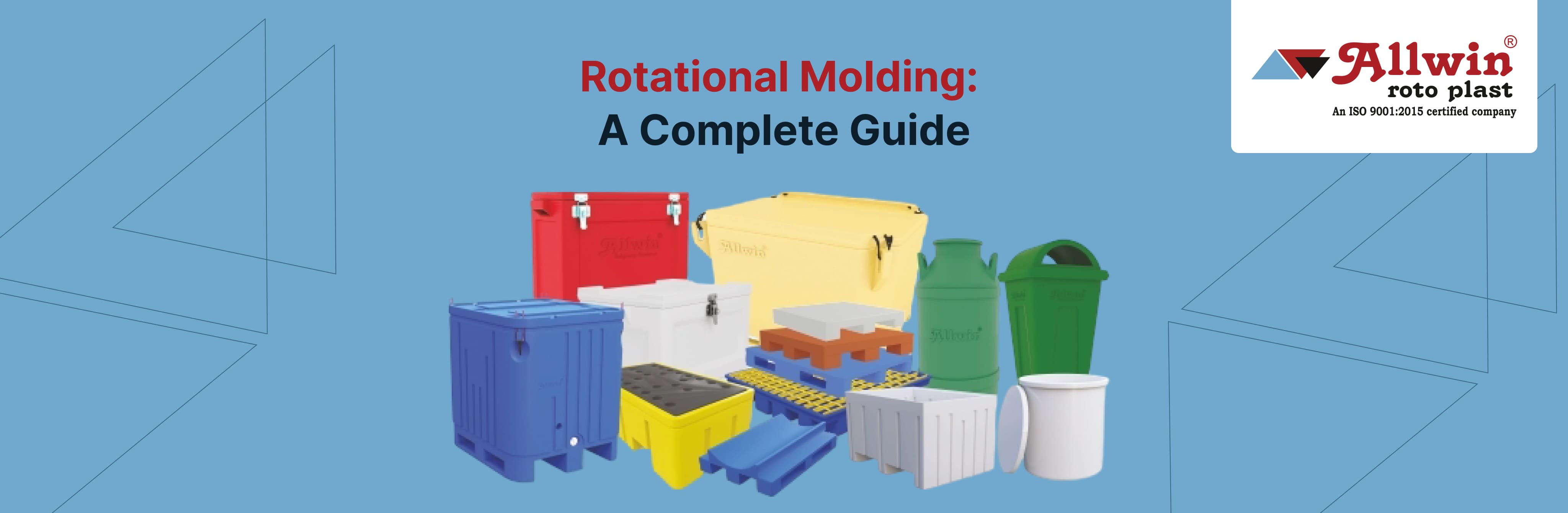
Rotational molding (commonly referred to as roto molding) is a productive process that allows for the manufacturing of many different shapes of large, hollow, seamless products (especially plastic). Unlike injection or blow molding - both of which use resin feedstock in the form of pellets (along with heat) - rotational molding uses powdered plastic resin and involves heating the resin while the part is rotated slowly in more than one axis to produce strong, stress-free parts. These parts can be durable, light, and made for individual specifications depending on the needs of partners in each industry.
From Plastic Pallets and Fish Tubs to Ice Box, Dustbin, and large industrial containers, roto moulded products have become the go-to choice for businesses looking for cost-effective, long-lasting solutions.
This guide will consider what rotational molding products manufacturing is, how it works, what to use it for, its benefits, and why it is essential for success to select a suitable rotational molding manufacturer.
The Importance of Rotational Molding
Fundamentally, rotational molding provides seamless, uniform, and reliable products. This is due to the even distribution of material - free of stress in the corners of the molded part, better wall thickness distribution, efficiency of material use, and strength of its components.
The rotational molding manufacturing technology is critically important to industries relying on strong, safe, hygienic, and durable applications. These industries include but are not limited to, food processing, pharmaceuticals, agriculture, and logistics. The rotational molding technology ensures design flexibility and natural strength are achieved for the industries relying on custom rotational molding products.
How Rotational Molding Works
- Filling the Mold - Powdered resin is loaded into a hollow mold. This is an essential to step because the type and quantity of resin used will indicate the strength, durability, and wall thickness of the part. Manufacturers may also add colorants, UV stabilizers, or other additives onto the pre-fill mold to achieve functional or aesthetic properties. Proper fill will ensure uniformity of material during the rotation step.
- Heating & Rotation - The mold is heated and rotated about two axes so that the resin melts and coats the mold surface evenly. Bi-axial rotation is essential to a uniform wall thickness and smooth surface finish. Heat and movement encourage the resin to flow equally through the entire part to the corner of the mold; this helps eliminate stress points and weak areas. This condition allows complexity in shape, texture, or internal characteristics without additional post-processing.
- Cooling - The mold is cooled, allowing the part to be solidified without the introduction of stress points. The cooling process can naturally occur through the air, or be accelerated with the use of water or fans, depending on the size of the product and the material. Controlled cooling is necessary for dimensional accuracy during the cooling process to avoid warpage, and maintain the structural integrity of the rotational molded product. Properly cooled parts are durable and free from stress points, ready for their intended industrial or consumer application.
- Demolding - The part is demolded, strong, seamless and ready for use. This concludes the rotational molding process, providing a product that is not only strong, but uniform in appearance and performance. This step involves any final finishing steps that involve trimming excess material, or minor surface treatment of the molded part before deployment.
See Also – Rotational Molding: A Closer Look at the Products It Creates
This organized method helps manufacturers produce custom plastic molding solutions that vary from small consumer items to large industrial rotational molding items uniformly, efficiently, and with quality and reliability.
Applications of Rotational Molding
Because of its flexibility, roto moulded products are widely used across multiple industries. Some key examples include:
- Plastic Pallets for warehousing, storage, and logistics. These pallets are durable but still lightweight, which makes them easier to move and handle repeatedly. Their smooth design also creates a lower risk of contamination points that are crucial for food, pharmaceutical and other industries.
- Fish Tubs for hygienic seafood handling. They are water-resistant, easy to clean and durable enough for rough handling. The goal of these tubs is to insure product survival and hygiene is maintained through the entirety of the supply chain.
- Ice Box for cold storage and transport. Roto molded ice boxes have a high degree of insulation and durability that make them an ideal option for sensitive temperature-sensitive goods. These types of ice boxes are heavily used in food distribution, pharmaceuticals, or laboratories that require acceptable cold chain needs.
- Doff Basket for textile operations. These baskets are lightweight, easy to handle, and ergonomically designed for heavy fabrics. They can enhance workflow efficiency in textile mills and decrease material damage during handling.
- Milk Can for safe dairy distribution. The milk cans' hygienic surfaces and resistance to chemicals allow for milk to be transported and stored without fear of contamination. They are also durable and hold closure without the risk of spilling, making them the preferred option in distribution by dairies.
- Dustbin for effective waste collection. Since they are impact-resistant and weatherproof, roto molded dustbins are ideal for municipal or industrial waste collection. Their seamless construction allows for a leak-free solution and easier to clean.
- Pallet Container for industrial storage solutions. These containers are used to securely and efficiently store bulk materials. Their stackable design allows for optimal space usage in a warehouse, and provides durability for repeated use over long periods.
- Custom Rotational Moulding for industrial storage solutions. These containers are used to securely and efficiently store bulk materials. Their stackable design allows for optimal space usage in a warehouse, and provides durability for repeated use over long periods.
Advantages of Rotational Molding
There are many advantages of rotational molding, making it a preferred choice for industries seeking durable and versatile plastic products:
- Durability – Items produced through the rotary molding process are stress-free, resistant to impact, and durable. The product's consistent wall thickness and absence of seams provide a reduction of weak points in the product, allowing it to endure heavy use and demanding environments. This is one of the reasons roto moulded products are popularly used for industrial storage, logistics, and food or chemical environments.
- Design Flexibility – The process provides the versatility of producing complicated shapes, textures, and custom rotomolding applications which can amount to challenges or cost prohibitive projects in other molding processes. Whether producing an ergonomic handle or an intricate interior feature, your designer or engineer is assured of the flexibility of the materials that will allow for the design to meet both functional and aesthetic needs.
- Cost-Effectiveness – Tooling costs for the manufacture of the product with rotational molding are significantly lower than injection molding of competitive products, especially in large or hollow parts. Minimal post-processing reduces labor time and waste of materials which greatly improves overall cost-effectiveness of each custom-designed product produced.
- Eco-Friendly Production – Many of the materials used for rotational moulding are recyclable or reused, which means that waste is significantly reduced. This means rotational moulding will be an environmentally sustainable alternative for businesses that would like to improve their green initiatives and still create durable custom rotational molding products.
- Consistency – Roto moulded products provide smooth surfaces and consistent wall thickness that ensure high-quality outputs with reduced reject rates. The consistency of product quality also improves the downstream process of assembly, packaging, or distribution.
For companies seeking custom rotomolding services, these advantages frequently translate into improved performance, long-term reliability, and a stronger return on investment, making it a strategic choice for business growth.
Challenges & Considerations
Despite its many strengths, rotational molding comes with certain challenges that manufacturers and businesses should be aware of:
- Material Limitations – Compared to other molding techniques, there are fewer materials for rotational moulding available. Most applications rely on polyethylene (PE) or polypropylene (PP), which may limit options for specific performance requirements.
- Longer Cycle Times – Because the process involves heating and cooling the mold, production cycles are slower than injection or blow molding. This can affect throughput for businesses with extremely high-volume requirements.
- Volume Constraints – While ideal for medium- and large-sized products, rotational molding products manufacturing may not be the fastest or most cost-effective solution for mass-producing small items in very large quantities.
Despite these points, industries that prioritize custom rotational molding products, durability, and consistent quality continue to rely on rotational molding manufacturing technology. The benefits in customization, long-term cost savings, and product performance often outweigh the limitations, making it an essential process for many industrial and commercial applications.
Cost, Efficiency & Sustainability
The investment into manufacturing rotational molding products is some of the most affordable regarding materials utilized, longevity of product, and the overall scale of the finished product. The costs of tooling, for example, are significantly lower, as compared to injection molding. Waste material that comes from raw materials is minimal and the process is sustainable in terms of recycling the product itself.
Polyethylene and polypropylene are the two most common materials designed to produce products with a rotational molding process. Both materials contribute to sustainable products, end-products are durable as well. From a manufacturer perspective, it can provide higher efficiencies, lower production costs, and sustainability growth, to do work with a competent roto molding company.
Why Choose Allwin for Rotational Molding
Allwin is a trusted rotational moulding product manufacturer delivering reliable, durable, and innovative solutions. From Plastic Pallets and Milk Cans to Custom Rotational Moulding projects, Allwin’s expertise ensures unmatched quality and efficiency.
Through our state-of-the-art rotational molding manufacturing technology, we offer both custom rotomolding services and custom rotomolding solutions for a variety of industry-related requirements. As a leading rotational molding manufacturer, our products are durable and sustainable.

Conclusion
Rotational molding is not just another production method—it is a proven solution for creating strong, reliable, and customizable products across industries. Whether it’s Fish Tubs for seafood, Dustbins for waste management, or Pallet Containers for industrial storage, this process delivers unmatched efficiency and durability.
Partnering with an experienced rotational molding manufacturer like Allwin ensures your business benefits from cost-effective, high-performance, and sustainable rotational molding products.