
2026-02-06
The seafood industry runs on one promise: fish reaches the customer in good condition. But fish's highly perishable quality can drop fast when temperature control slips, ice handling is inconsistent, or product sits too long during transfers. That’s why seafood logistics is not just “moving boxes.” It’s about holding freshness through every touchpoint: landing, sorting, auction, processing, cold storage, distribution, and final delivery to retail or foodservice.
Seafood handling in the UK also happens on a serious scale, which makes container choice more important than many buyers realise. Official statistics show UK vessels landed 745 thousand tonnes of sea fish in 2024 (value £1.16 billion), and 719 thousand tonnes in 2023 (value £1.1 billion). When operations run at this volume, small handling weaknesses repeat thousands of times, soft containers, poor drainage, unstable stacks, slow cleaning, and faster ice melt all turn into recurring costs and quality loss.
This is where fish tubs (and insulated fish boxes) become the quiet infrastructure of seafood handling. Industry sources commonly cite “over 22 million” fish boxes used across UK seafood supply chains annually, useful as an indicator of scale, though figures can vary depending on definition and reporting source. The bigger point is simple: containers are not “just storage.” They influence hygiene discipline, temperature stability, product damage rates, and overall operational speed.
This guide explains what fish tubs are, the types UK buyers use, where they’re used, what commonly goes wrong during purchasing, and how to choose the right fish tubs in bulk, especially if you’re searching for fish tubs UK, insulated fish tubs UK, and heavy-duty rotomoulded fish tubs that stay reliable through repeated cycles.
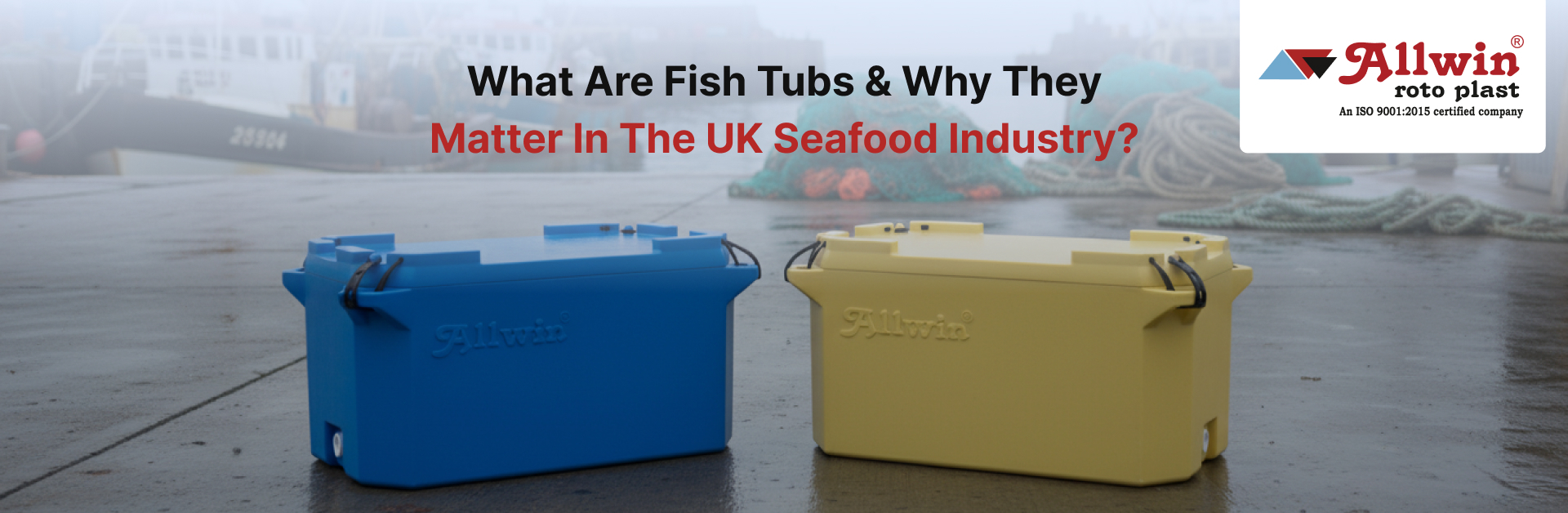
Fish tubs are purpose-built fish storage containers for the seafood industry. They’re designed to hold fish with ice (or chilled product) while supporting hygiene, stacking, and rough daily handling. A good tub protects product quality in two ways: it helps maintain temperature, and it helps maintain physical condition (less crushing, less leakage mess, fewer handling failures).
What separates commercial fish tubs from general bins is how they behave under pressure. In seafood operations, tubs are washed, refilled, moved, stacked, drained, and reused, often many times per week. That means insulation, wall strength, rim integrity, and drainage behaviour become operational requirements, not product features.
After you’ve mapped your handling lane (ice load, stacking height, wash routine, forklift use), that’s where Allwin Roto Plast becomes relevant as a supplier because their fish tub portfolio is organised by commercial capacities and bulk-use formats rather than “one size for all.”
Key characteristics of commercial fish tubs:
UK buyers don’t buy “a fish tub.” They buy a tub for a specific workflow, landing, processing, cold room staging, bulk holding, or transport. That’s why the best way to classify fish tubs is by how long they must hold temperature, how much load they carry, and how harsh the handling environment is.
In practice, most purchasing decisions come down to two choices: insulation level and duty level. If the operation is high-turn and rough, a heavy-duty build matters more than anything. If the lane includes longer transfer windows, insulation becomes the deciding factor.
Common fish tub categories UK buyers compare:
See Also: Customizable Ice Boxes for UK Businesses: Sizes, Colours & Use Cases
Fish tubs show up across the seafood chain because they support the “fast steps” where quality can drop. A tub isn’t only for storage; it’s also part of how fish are protected during movement, staging, and loading. When tubs are right, handling stays clean and predictable; when tubs are wrong, teams spend time dealing with water mess, unstable stacks, and avoidable damage.
In UK seafood operations, tubs are most common in high-turn environments where washdown is routine, and product moves through multiple hands quickly.
Typical UK use points:
Learn: From Catch to Customer: How Ice Boxes & Fish Tubs Keep Seafood Fresh
Most issues come from buying tubs like commodities, choosing only by price or “litres” without matching the tub to the lane. The cost shows up later as breakage, messy floors, slower cleaning, and inconsistent stacking that disrupts workflow.
If you want fewer problems, the goal is simple: avoid design mismatch. A tub that works on a processing floor may fail in a cold store; a tub that stacks fine empty may slide when wet and loaded; a tub that looks insulated may still lose ice too quickly for your holding time.
Common buyer pain points:
Wood isn’t automatically “bad,” but seafood is a wet, high-residue environment. That makes hygiene and repeatability harder with wood over time. In many UK lanes, plastic tubs are chosen because they’re easier to control: condition stays more consistent, cleaning is faster, and handling is more predictable across a fleet.
Plastic tubs also remove common practical problems: splinters, absorbed odours, and inconsistent repairs. For businesses that want fewer exceptions and more reliable cold-chain handling, the switch is usually a straightforward operational decision.
Why plastic is taking a share in UK seafood lanes:
Bulk fish tubs buying isn’t only about getting a lower unit price. It’s usually about standardising operations: one spec, one stacking rule, one wash routine, and easier training across shifts. In seafood handling, that consistency reduces mess, reduces breakage, and improves planning.
Bulk purchasing also supports returnable loops. If tubs circulate between sites, consistent fleets from a bulk fish tubs supplier in UK reduce loss, simplify sorting, and make the backhaul process smoother.
Why is bulk fish tubs UK purchasing common:
Related Blog: Insulated Shipper Boxes: Everything You Need to Know
Customisation in seafood is often about operations, not aesthetics. Buyers customize to reduce loss, improve sorting, strengthen accountability, and keep handling disciplined. Even simple changes, such as colour, coding by species/zone, or adding branding, can reduce mix-ups and improve return control.
If your tubs move outside your site (wholesalers, distributors, shared cold stores), branding becomes even more useful because it helps protect the fleet from “drifting” into other systems.
Practical customisation benefits:
Custom options should stay practical and repeatable. Over-customising can increase complexity without improving outcomes. The best custom features are ones that reduce exceptions: branding, colour coding, and clear identification zones.
This is where Allwin Roto Plast is a useful reference point: they explicitly position custom fish tubs for fisheries and commercial seafood handling, including branding-oriented options that align with bulk fleet control.
Common custom options buyers request:
The best buying process starts with the lane: how long is the product out of cold storage, how much ice is used, what is the stack height, how often is washdown done, and is movement manual or equipment-based. Once you define those inputs, the “right tub” becomes much easier to choose.
Also, don’t treat “insulated” as a checkbox. Ask what “insulated” needs to achieve in your workflow: short transfers, longer staging, or cold room holding. That’s where buyers either win or waste money.
UK buyer checklist:
Learn: How Fish Tubs Keep Fish Fresh and Safe
Capacity selection should be practical: bigger isn’t always better. Large tubs reduce transfers but can become heavy and harder to handle; smaller tubs are easier to move and ice consistently, but you may need more units. Many UK seafood operators standardise 2–3 sizes: a smaller handling size, a mid-size bulk mover, and a large industrial staging size.
When planning sizes, think about: weight when loaded, typical ice ratio, stacking height, and whether movement is manual, palletised, or forklift-based.
Common capacity logic UK buyers use:
Sustainability is measured in cycles. A tub is “more sustainable” only if it survives many trips and returns reliably. That’s why durability and return discipline matter more than marketing claims. A reusable container program can reduce packaging churn, but the win depends on trip count, loss rate, and end-of-life handling.
Reusable fleets also reduce product waste indirectly if handling is cleaner and colder, fewer loads are downgraded or rejected. In seafood, that “quality protection” effect is often as valuable as the packaging reduction.
Practical sustainability levers:
UK seafood handling sits within a broader food hygiene framework where temperature control and cleanliness are fundamental. In practice, buyers should treat fish tubs as part of a larger SOP: ice management, cleaning schedules, segregation rules, and controlled holding times.
It’s also important to write compliance language carefully. Many UK guides reference 8°C or below as a general chilled food threshold, but businesses often target colder settings depending on product risk and process design. The safest approach is to align tubs with your operational control plan, cleanability, drainage, and temperature discipline, working together.
What this means for fish tubs in practice:
Supplier selection is not about who can sell “a tub.” It’s about who can supply a consistent fleet that stacks the same, handles the same, and washes the same batch after batch. UK seafood businesses that buy in bulk need repeatability and clarity: sizes, capacity options, and predictable supply.
This is where Allwin Roto Plast fits into UK purchasing: a structured range, bulk-friendly supply mindset, and a focus on heavy-duty formats aligned to commercial seafood workflows.
Supplier checklist (and why it matters):

Fish tubs are not just containers; they're cold-chain tools that protect quality, hygiene, and operational speed. In the UK seafood industry, where product moves quickly, and handling is high-turn, tub choice affects everything: ice retention, drainage control, stacking stability, cleaning time, and the overall discipline of seafood movement.
The best buying decisions are lane-based. Define your handling window, ice usage, stack height, cleaning routine, and movement method, then choose tubs that match those conditions. Standardise where possible, test in real operations, and prioritise repeatability over price-only selection.
If you’re sourcing insulated fish tubs UK, buying plastic fish tubs bulk UK, or looking for branded seafood storage containers, Allwin Roto Plast is a strong option for commercial fleets that need structured sizing and repeatable heavy-duty supply.