
2026-09-16
A fundamental aspect to consider when food, medicine, dairy, fish, and other such products are in transit is managing them at ambient temperatures. Insulated containers would manage this by minimizing heat transfer with respect to the external environment, as well as act as a protective surface for the chilled/temperature-sensitive products in transit or temporary storage with ice packs/thermoses without needing any powered refrigeration through the entire distribution process.
A cold chain enterprise needs to consider specific attributes when selecting insulated boxes, which range from capability, insulation, and structure to the nature of the product, length of transit, and handling procedures. With an apt insulated container that will decrease loss and damage to the product owing to temperature, transportation, and warehousing can be reduced efficiently in a reliable manner.
A storage or transport unit with a wall constructed to contain insulation between an inner and outer surface that restricts heat transfer. An insulated container generally fares better with less temperature fluctuation compared to an uninsulated container because the insulation slows down heat transfer.
An insulated shipping container is used when transporting products between places like plants, stores, or customers. Its value is increased by the container's use in conjunction with appropriate coolants or appropriate packing.
Insulated containers, as compared to ordinary cardboard boxes, are built to maintain appropriate thermal environments during transport and for relatively brief periods of time. Insulated boxes are effective depending on the insulation material, wall construction, lid design, sealing, container size, product being transported, outside temperature, and how often the container is opened.
Variability in temperature can have an impact on a range of products' quality, shelf life, safety, and use. Foods and seafood can go off if exposed to high temperatures, but products such as pharmaceuticals require precise transport and storage instructions throughout their distribution.
A thermal insulated container controls the rate of thermal influx or outflow of the internal space. The benefit here will come from products in transit through loading docks, transport vehicles, distribution centers, and other locations with potentially unpredictable cooling.
For temperature-sensitive logistics, maintaining suitable temperature is not just a function of the container; coolants used, packing arrangements, carriage time, product layout, and temperature loggers are all variables in that equation.
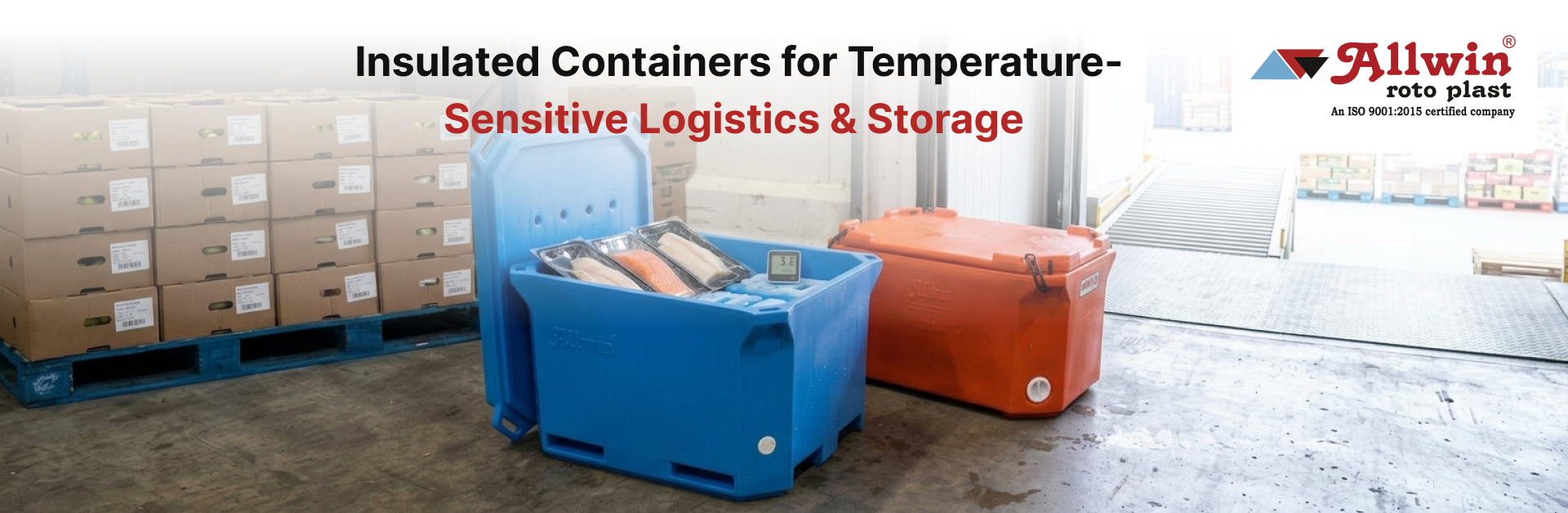
Choosing the insulated container is guided by factors such as how much you need to store what the product is, how far it travels how it is handled and the temperature required.Allwin sells ice boxes that hold 20 to 250 liters and insulated fish tubs that hold 70 to 1,250 liters.These insulated ice boxes and insulated fish tubs give you the storage capacity, for different transportation jobs and cold‑chain uses.
Insulated ice boxes serve a variety of storage and transportation needs for foods and drinks, medicines, seafood, and other perishable products. Allwin defines its ice boxes as insulated storage and transportation goods, and the company provides premium insulated ice boxes in an assortment of sizes for diverse needs.
Insulated fish tubs can be used to store and transport fresh seafood or fish. Allwin offers a range of insulated fish tubs available in sizes such as 70,100, 220,260, 310,460, 660,1000 and 1250 liters. Allwin insists all their fish tubs are constructed from food-grade polyethylene in a wide array of shapes and sizes.
In cases that require higher volume capacities and sturdy structure for commercial handling, bigger sizes of insulated containers are utilized. This is often applicable to some food industries, the distribution of seafood and other cold storage logistics, and commercial shipment, where certain products require resistance to external elements of the environment
Durability, cleanliness, structural strength, and the ease of cleaning are all dependent on the materials used. Allwin indicates polyethylene as a component of their fish bins, whereas the details for its ice box suggest a high-quality polyethylene outer body and polyurethane foam for insulation.
Thermal packs are the cooling source positioned within a box to absorb heat and establish the expected contents' temperature. While insulation limits heat intrusion, thermal packs provide the cooling needed during transit. The number, nature, and disposition of these items need to be based on factors like the volume of packaging, amount of products carried, initial temperature, desired final temperatures, surrounding temperature, and estimated travel duration.
In fact, for certain products the 'cold' packs could prove to be as problematic as their insufficient presence within the box. Items vulnerable to freezing, for instance, could fail to come in direct contact with very cold cooling elements. The cooling media thus would need to be configured to keep a homogeneous temperature distribution within the carried goods.
A properly designed combination of insulation, thermal packs, and packing configuration forms an important part of temperature-controlled packaging.
These containers are widely employed across industries whenever products require preservation from temperature variations when being transported, distributed, or stored temporarily.
Medicines, vaccines, biologically sensitive components, and many other medical products need to be kept at controlled temperatures when in transit. An insulated shipping container system and cooling system can provide thermal protection during shipment from manufacturer to distributor, to pharmacy or clinic, to hospital, etc.
Seafood deteriorates very quickly when stored or conveyed in the incorrect conditions. Insulated tubs & containers should be used when conveying fish from boat/shore landings to the processing sites/cold stores/markets & distribution centers.
Insulated packaging can also be used for transporting food products, drinks, frozen foods, convenience items, and many other perishable goods. This packaging provides increased insulation of contents from ambient heat during delivery/last-mile transport.
Refrigeration can also be necessary to ensure quality control over products such as milk, cheese, butter, ice cream, etc. Short and medium-distance transport could use insulated containers to reduce the amount of heat affecting such products.
Overheating during shipment can damage fresh produce, fruits, vegetables, and other products of the farm. Appropriate selection of insulated containers is the best approach to minimize temperature exposure during pickup, delivery, and transit.
Retailers and distributors could use refrigerated containers for delivery of cold products and their transfer between locations. This is potentially useful for last-leg delivery with a multi-drop route or periods out of the cold chain.
These applications demonstrate why insulated containers for shipping are useful across different stages of modern cold-chain distribution. Overall, insulated containers help maintain suitable temperature conditions across pharmaceutical, seafood, food, dairy, agricultural, and retail applications. For higher-volume industrial handling, heavy-duty insulated pallet containers for industrial use provide added durability and protection during storage and transportation.
The specific application details will, of course, change based on the application and container, but in business you generally want thermal performance, toughness, and hygiene at a business level, along with easy handling features.
Effective Insulation: This layer of insulation is designed to lower the transfer of heat between the container's contents and the environment.
Secure Closure: To avoid extra exposure to the air as much as possible, ensure your lid fits snugly so as to make a tight seal possible, as this is more relevant for long transport.
Durable Construction: A commercial container has to undergo several processes, including packing and repacking, movement, and loading and unloading time after time. A well-constructed container is likely to suffer from the potential risk of being damaged during regular logistics operations.
Suitable Capacity: There are also three sizes available for businesses to accommodate varying amounts of product in their container. Allwin's product line features 20 to 250-liter capacity ice boxes and up to 1250-liter fish tubs.
Easy Cleaning: The importance of smooth, cleanable surfaces comes up frequently when you look at the following applications: food, seafood, dairy, and pharmaceutical products, where sanitation is a main issue.
Customisation: Businesses that have unique operational needs could perhaps use customized sizes, designs, colors, or other specifications. Allwin claims to offer its insulated items with customized needs.
When temperatures can rise or fall externally, and items are required to be guarded against the elements, the use of insulated boxes could prove to be highly functional.
Insulation slows down heat but does not show the actual temperature at which the product is kept. Hence, for goods with established temperature limits, the monitoring of temperature becomes crucial. Temperature monitoring devices, also called temperature loggers, can document fluctuations in temperature during delivery and may have a history that can be reviewed. Advanced solutions can provide real-time information.
However, careful placement of the monitor will provide a reading that represents the conditions around the product well, and establishing a set of parameters (acceptable limits) is key before dispatch. The procedures for managing temperature deviations should also be implemented.Especially crucial for longer delivery routes, where the goods pass many points of contact, during extreme seasonal temperature variations, and especially for value items.
Combining temperature monitoring with temperature controlled packaging allows businesses to both protect the shipment and verify the conditions it experienced.
Business failure in transit may occur even with the best insulated container, as long as it is selected or filled with the wrong item. These common mistakes can help a business avoid such issues. Considerations include the size of the container, the type of cool media used, packing arrangements, and length of exposure.
Select the best container for your product, not just the size and cost of it. Consider the entire length of your transport, the cooling medium, handling, the overall environmental temperature, and where the product will be traveling during this time. This will help identify the most suitable container to transport your cargo and ensure the effectiveness you desire.
1. Identify the Temperature Requirement: Find the acceptable temperature range of the product before selecting a container. Transporting chilled, frozen, and controlled-ambient products may require a different approach to the packaging. If you know the range you may also ascertain the type and amounts of cooling media that will be needed.
2. Determine the Required Capacity: Determine the volume and weight of the shipment. The container should be large enough to contain the shipment and the cooling media, but not so large as to leave unnecessary space.
3. Consider Transit Duration: The length of the journey also significantly affects both the insulating properties and cooling requirements. A local delivery may simply have shorter trip times and may not require the same level of insulation or cooling capacity as a longer overseas delivery.
4. Evaluate Handling Conditions: Durability is important if containers are to be loaded, unloaded, stacked or moved many times. Look at the type of equipment that will be used to handle the container, and the environment in which it will be used.
5. Consider Hygiene: Products such as food and beverage, seafood, dairy, and pharmaceutical manufacturers need containers that are straightforward to clean.
6. Plan for Reuse: For containers that will be used multiple times, take durability, ease of cleaning, ease of handling, and anticipated lifetime into account. Reusable insulated containers may be a good solution for companies that already have regular delivery schedules.
7. Evaluate Supplier Capabilities: When dealing with repeat orders or bulk requirements for businesses, take into account product standardization, capacity, range, quality systems, and range of support.
For businesses comparing different insulated containers for shipping, the best option is the one that fits the actual product, packing process, transit conditions, and handling requirements.
Consumers' containers (for products such as seafood, dairy, pharmaceuticals, foods, etc.) require regular clearance of contents. After the product or its ice/cooling medium has been emptied, the container should be cleaned thoroughly, the most appropriate cleaning technique used (look in every corner of the container and inside the lid and handles), and left to drain and dry for future use.
It also makes sense to wash the outside of the container too. Any damage to the container will need to be assessed prior to use (if the lids, handles, and walls are cracked etc.).
A consistent cleaning and inspection routine can help maintain the performance and hygiene of an insulated storage container throughout repeated use.
Allwin Roto Plast has been roto-moulding plastics for over 20 years and provides insulated ice boxes and fish tubs that can be used in industries such as food, pharma, fishing, dairy, or anything else that needs to be maintained at a certain temperature. Currently, the different models of ice boxes available range from 20L to 250L. As an insulated ice box manufacturer and supplier, Allwin offers a range of solutions for different storage and transportation requirements.
For businesses looking for a wider range of cold-chain storage options, premium insulated ice boxes are available in multiple capacities to suit different storage and transportation requirements. Allwin claims their ice boxes are used to carry food, drinks, medicines, seafood, vegetables, and fruits, as well as for logistics services. Their key competitive advantages include ISO 9001:2015 certification, extensive experience in the roto moulding industry, customization and product development capabilities, and a varied range of plastic products.

An insulated shipping container comprises an insulation layer that may be used within a shipping container to prevent heat transfer between the outside environment and the space inside. With the appropriate use of ice or thermal packs, such insulation can prolong the life of the shipping container.
The duration of temperature retention is not a standard quantity. It is dependent on the type of insulation, size of container, load of product, quantity of cooling media, ambient temperature, arrangement of packing, and duration of transit. All these aspects should be considered in a comprehensive manner for the specific application.
These can be placed inside of temperature sensitive packaging for medicines, vaccines, biological substances, and other healthcare products. The container and cooling setup should be based on the specific required temperature range for the product and tested for the expected transportation conditions.
The required size depends on the product volume, product arrangement, cooling-media requirements, handling method, and expected transit duration. Larger commercial applications may require insulated tubs or high-capacity containers, while smaller consignments may be better suited to compact insulated boxes. Allwin currently offers ice boxes from 20 to 250 liters and fish tubs from 70 to 1250 liters.